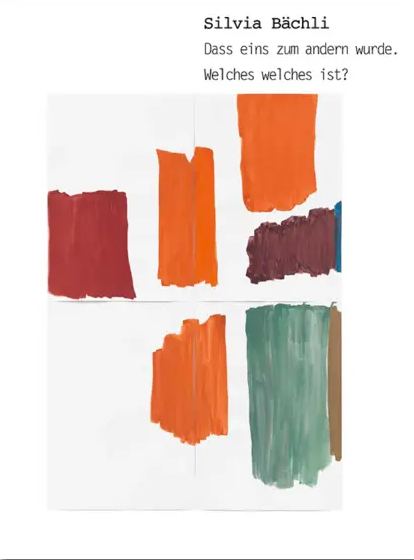
Un aperçu des multiples facettes de l'œuvre de Silvia Bächli.
Drawing is entering new territory and walking about in it! Silvia Bächli has been developing her work as a draughtswoman since the late 1970s with equal measures of care and consistency. The expressive approach to corporeality has given way to an almost introspective view of reality. Everyday perception forms the point of departure for Silvia Bächli's artistic process, in the course of which she appropriates things in order to give them an autonomous graphic form. And since 1984 she has combined her small-format drawings into multi-part compositions on the wall. From 2001 she worked on large-format works on paper with overlapping, finely articulated linear structures; in recent years the plane of colour has additionally been placed in relation to the ground of the picture. Silvia Bächli's quiet body of work is now recognised worldwide, as exhibitions at the Centre Pompidou in Paris in 2007, at the Staatliche Graphische Sammlung in Munich in 2014, at the Museum Weserburg in Bremen in 2022 and at the Centro Botin in Santander in 2024 attest. In 2009 she represented Switzerland at the 53rd Biennale in Venice. The exhibition at the Kunst Museum Winterthur, entitled "Dass eins zum andern wurde. Welches welches ist?", goes back to a quotation from the American poet Elizabeth Bishop, and the picture book conceived by Silvia Bächli offers an overview of this multifaceted body of work – for the first time in Switzerland a series of small-scale sculptures is being presented. "My work is an approach to something that I do not know precisely and that I only find out in the doing," she says.
Silvia Bächli (née en 1956 à Baden) est une artiste suisse qui se consacre depuis la fin des années 1970 au dessin, devenu un exercice constant, étroitement lié au corps et aux mouvements, avec lesquels elle interagit aussi bien dans la sphère intime que dans le paysage. Ses dessins, qu'elle considère comme des mots, des notes, avec lesquels elle compose des « phrases musicales » au mur, peuvent être interprétés comme des empreintes de repères sensoriels – une promenade dans la campagne, un corps en souffrance, un poème provocateur – et des mouvements du corps – l'extension du bras, la force de la main ou le rythme du pinceau.