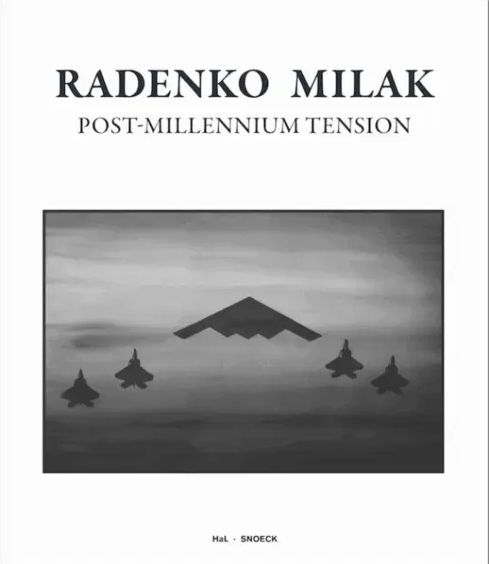
Monographie rétrospective.
When we see one of the watercolours by Radenko Milak for the first time, we think we "recognise" it, for there is always a before and an after, as in a film loop, and that is a unique quality of this work, writes Udo Kittelmann in his contribution. Standing in front of a picture by Radenko Milak, we believe we are seeing a detail of something larger, of a greater whole, of the world, of the universe, just as a photograph is always a detail of a theoretically endless image. In addition, almost every one of his motifs draws on an image we already know, because we have seen and stored it. Many factors therefore play a part in his work: the change of medium, from photography to watercolour, the question of original and reproduction, the choice of subjects, the way in which his pictures speak to our own and to the collective unconscious, for our memory is determined not only by language but above all by images. It is this congenial mastery of the medium, the illusion that arises when looking at photographs, but above all the experience of becoming witness to a change of medium. The original photograph becomes a watercolour, which the human eye perceives at first as a photograph and only subsequently as a painting. We want to grasp how it came about, to see for ourselves, and we always step so close that we are directly in front of it: in front of brushstroke, gesture, abstraction, craft. Over the years Radenko Milak has developed various series: architectural and urban views, technologies of the future, key moments in the history of music, of feminism, of surveillance, of big data, loneliness and isolation during the coronavirus pandemic, film stills. Radenko Milak has been pursuing these watercolour series asymmetrically for 20 years, and through the use of the very same black ink on white paper the pictures develop a serial character that lends them something absolutely timeless.
Radenko Milak (né en 1980 à Travnik, ex-Yougoslavie, vit et travaille à Banja Luka, Bosnie-Herzégovine) travaille sur des questions liées à la mémoire historique et à la manière dont les images façonnent notre perception du réel. En reprenant des photos de presse pour les réinterpréter sous forme d'aquarelles en noir et blanc très détaillées, il porte un regard sur les guerres, les catastrophes naturelles et les défis environnementaux en mettant en lumière le rôle prépondérant que jouent les médias dans la construction de la mémoire collective.