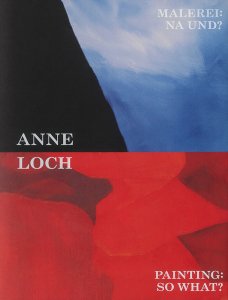
Anne Loch (1946-2014) was a German painter who for the most part conducted her artistic practice away from the public eye. As a painter, she championed a figurative visual language.
Loch studied painting in Düsseldorf in the 1970s before becoming active in the Cologne art scene, which at the time was a hub for contemporary art in the former West Germany. It was there that she exhibited alongside artists like
Rosemarie Trockel,
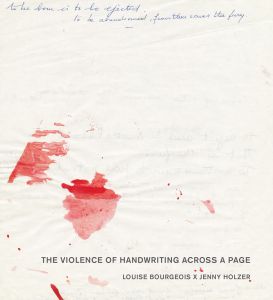
Jenny Holzer and
Cindy Sherman.. She seemed destined for a promising career. But in 1988, she radically withdrew, moving to Thusis in Switzerland. While living there, she quietly persevered with her creative practice and only occasionally exhibited her work, such as at the Erika and Otto Friedrich Gallery in Bern. In 2001, she returned to Germany, where she once again withdrew, largely isolating herself from the outside world and the art scene. She passed away in Bergell in 2014 following a brief illness.
In the wake of the Second World War, abstract art—such as abstract expressionism, minimal art and conceptual art—became dominant. It was not until the 1970s that painting found its way back to the "visible" world. Anne Loch plays a pioneering role in this development. In doing so, she establishes a distinctive visual language.
Her subject matter may appear trivial at first glance. But by enlarging her paintings to monumental proportions, they seem to lose all reference to their subject matter and to reality. Loch's primary interest was the act of painting itself – the exploration of colour, surface and space. Or, as Anne Loch puts it herself: "I just paint strokes and how they relate to each other."
Loch returned time and again to the same subject matter, but experimented with a vast array of techniques. Her oeuvre ranges from canvasses painted in rich, vibrant colours to sparse compositions consisting of only a few strokes. Her art invites us to conceive of painting not as a depiction of the world around us, but as its own self-contained means of seeing and experiencing.