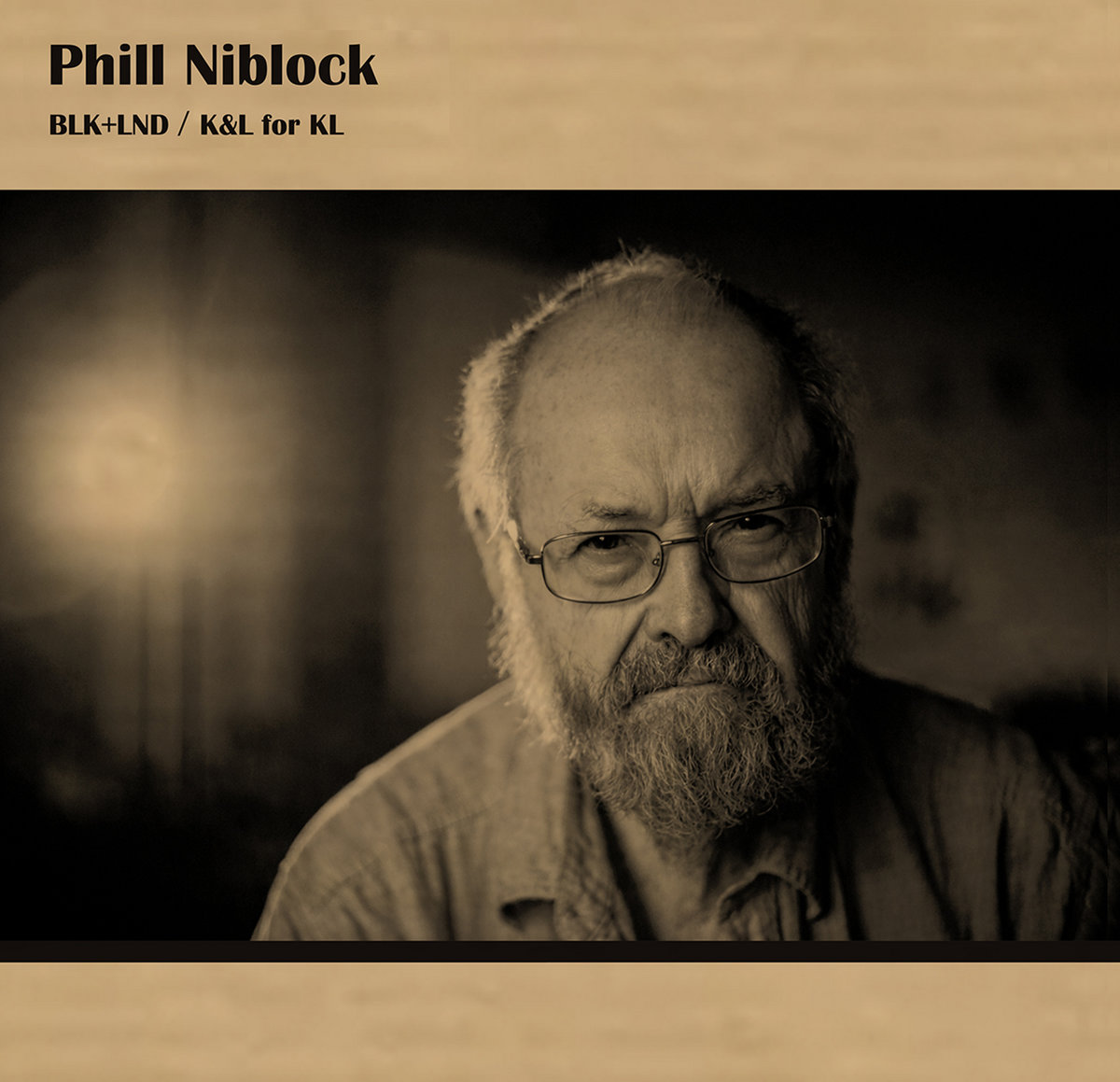
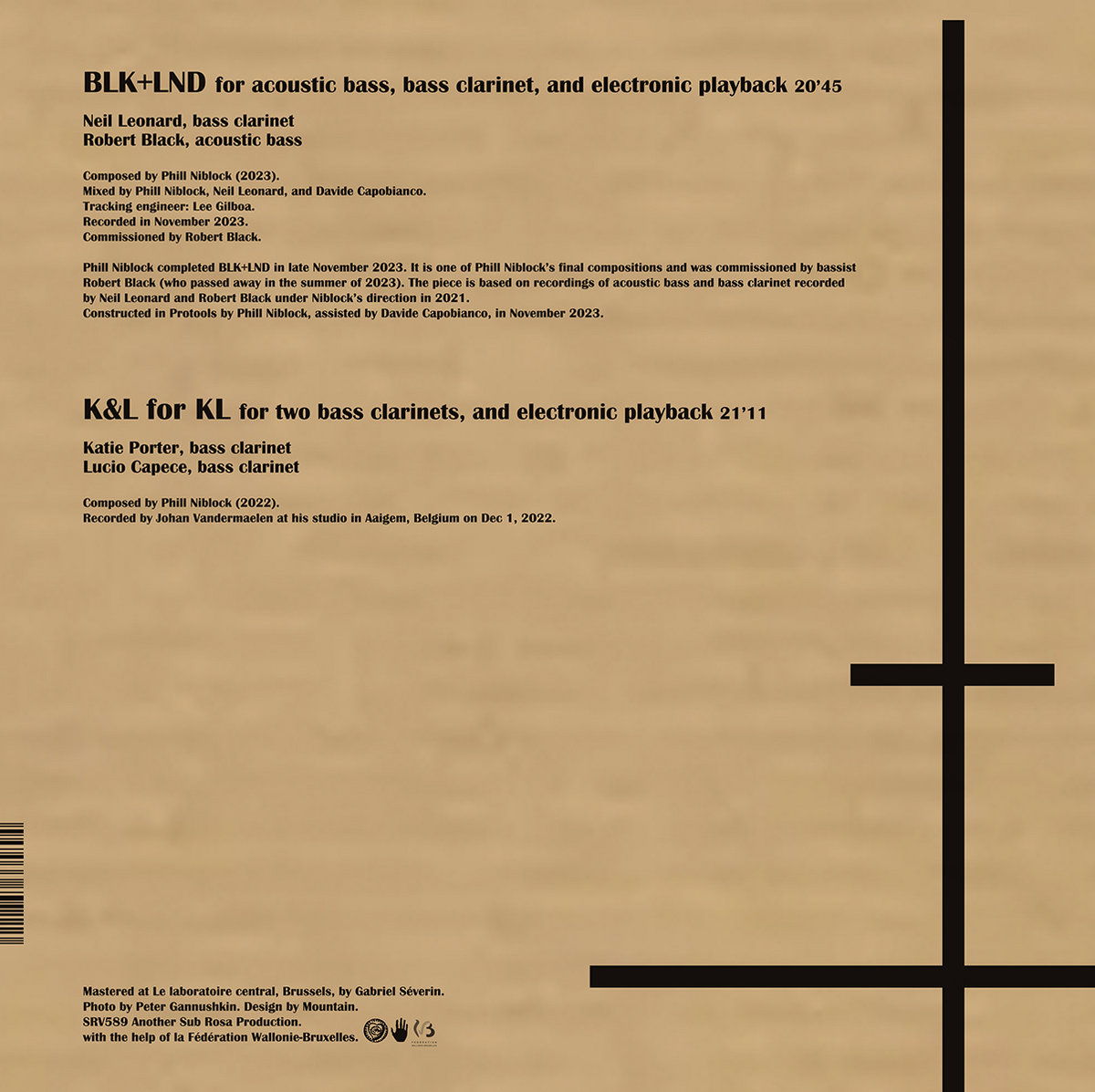
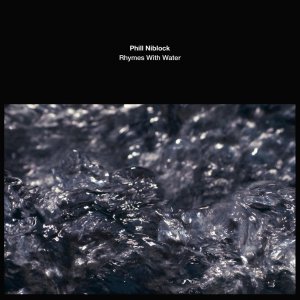
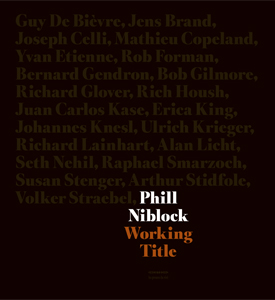
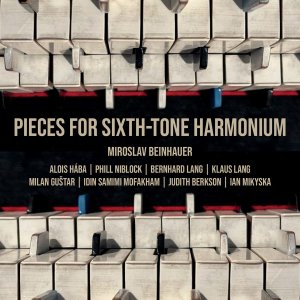
One of Phill Niblock's final compositions, commissioned by bassist Robert Black, completed in late November 2023,
based on recordings of acoustic bass and bass clarinet performed by Neil Leonard and Robert Black under Niblock's direction in 2021.
"No harmony. No melody. No rhythm. No bullshit.
Phill Niblock (1933-2024) as an artist whose fifty-year career spanned minimalist and experimental music, film and photography. He has been a maverick presence on the fringes of the avant-garde. In the history books he is the forgotten Minimalist. Since 1985, he served as director of Experimental Intermedia, a foundation for avant-garde music based in New York with a branch in Ghent, and curator of the foundation's record label XI. Known for his thick, loud drones of music, his signature sound is filled with microtones of instrumental timbres that generate many other tones in the performance space. He said: 'What I am doing with my music is to produce something without rhythm or melody, by using many microtones that cause movements very, very slowly.' In 2013, his diverse artistic career was the subject of a retrospective realized in partnership between Circuit (Centre d'art contemporain Lausanne) and Musée de l'Elysée (Paris).
The following year he was honored with the prestigious Foundation for Contemporary Arts John Cage Award. Since 1968 he also put on over 1000 concerts in his loft space in New York.
On January 6, 2024, two days before his passing, Phill called me to discuss the premiere and tour of BLK+LND. To distract him from his rapid decline, I engaged in his touring plan, only for him to reveal that all the details were still in his head and none of the events had been confirmed. He was entrusting the project to me. Phill would have been thrilled and honored by this concert at the Donaueschinger Musiktage. The thought of one more performance with Robert Black, whom he greatly admired, presenting his new work for low-pitched instruments that he was particularly fond of, andreconnecting with old and new friends in Donaueschingen would have meant the world to him".
Neil Leonard, Berklee College of Music, Boston
One of the most important multimedia artists of his generation, American
minimalist composer,
filmmaker and
video artist Phill Niblock (1933-2024) has produced a multidisciplinary work. His "Intermedia Art" features a combination of minimalist
music,
conceptual art, structural cinema, systematic or even political art, and has actively contributed to transform our perception and experience of
time.
Admittedly one of the greatest
experimental composers of our time, Phill Niblock initiated his career as a photographer and film director. A jazz passionate, he moved to New York in 1958 where he started photography In the mid-1960s, specializing in portraits of jazz musicians (Duke Ellington, Charles Mingus, Billy Strayhorn...). In the middle of the 1960s, he made his first films for the dancers and choreographers of the Judson Church Theater. From 1968 on, Phill Niblock focused on music and composed his first pieces, which, according to the artist, should be listened to at loud volume in order to explore their overtones. He pursued his film projects independently with
The Movement of People Working, a series of films lasting over 25 hours, made between 1973 and 1991, in which the repetitive nature of work movements acts as a direct echo to his musical compositions.
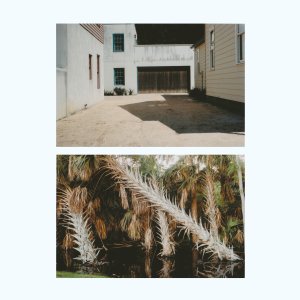
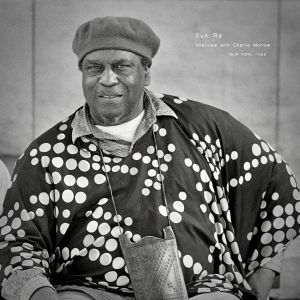
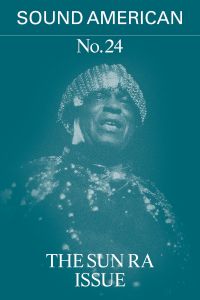
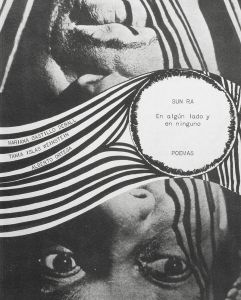
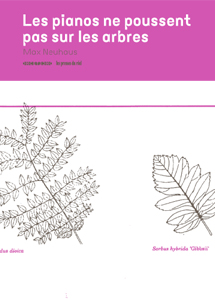
Since the mid-1960s, his analogue photographic work has explored New York's architecture and urban planning. The sequencing and layout of his images offer a mapping of the location and object photographed, such as the areas in South Bronx (1979) fallen into disuse or the facades of SoHo Broadway district (1988). Phill Niblock was particularly interested in the screening of moving images—films and slideshows. Produced between 1966 and 1969, Six Films, a series of short films with sound realized with 16mm film, heralds his experimental method through portraits of artists and musicians such as
Sun Ra and
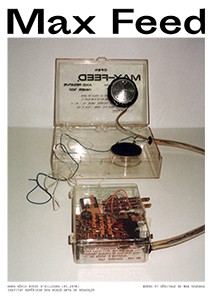
Max Neuhaus.
In 1968, the artist started experimenting a combination of his visual productions with his musical scores in order to create sound architectural and environmental compositions. Recreated by the artist for the first time since its last presentation in 1972 for the purpose of this exhibition, the Environments series extracts the reality of different surroundings through images, all the while generating a dense and intense temporary environment of projected images, music and movements throughout the museum space.
Phill Niblock was the director of Experimental Intermedia, a foundation born in the flames of 1968's barricade-hopping.