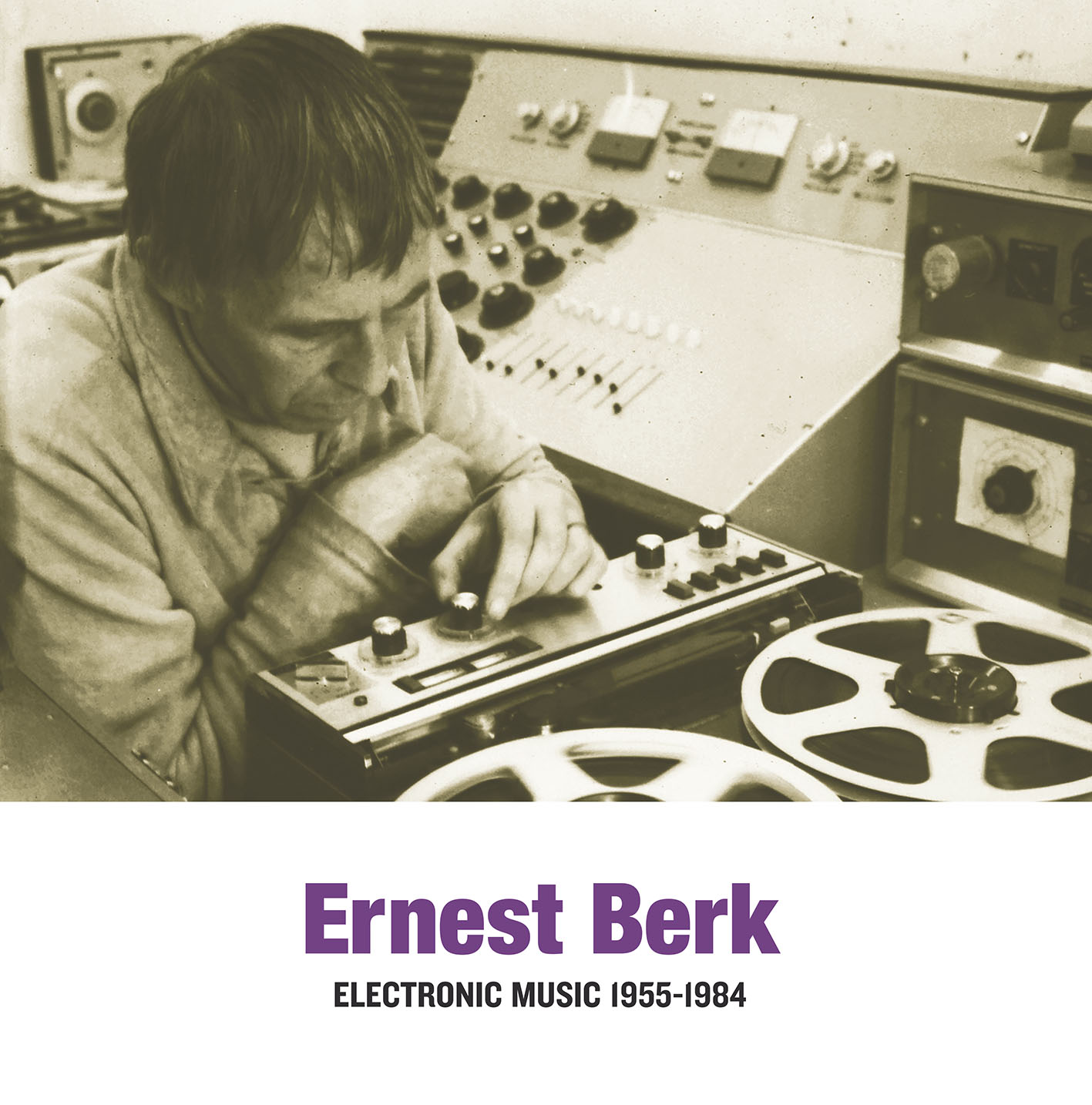
An audio anthology of the composer and choreographer Ernest Berk, a little-known pioneer of electronic and concrete music, creator of a prolific and visionary body of work, yet died in obscurity.
Ernest Berk fled Nazi Germany for London and spent three decades pioneering electronic music from a home-built studio - producing over 280 tape and musique concrète works, often to score his own radical expressionist dance. A true outsider-visionary, he shared the stage with Delia Derbyshire and Daphne Oram at the landmark 1968 Queen Elizabeth Hall electronic music concert, yet died in obscurity. This release restores Berk's place among Britain's most daring and most overlooked early sonic pioneers.
Composing across three North London studios - Camden Road, Dorset
Street, and the Diorama in Peto Place - Ernest Berk spent almost thirty
years fusing electronic composition with contemporary dance in a way
Britain had never seen and rarely has since. His closest counterpart
wasn't British at all: the American composer-choreographer Alwin
Nikolais, working an ocean away with the same radical instinct that
sound and movement were one discipline, not two.
Berk's musical language evolved from early tape manipulation, microphone recordings and radio interference towards electronically generated sounds produced with tone and white-noise generators. Yet through every
technological shift, he stuck to a strict economy of means, using often
just a handful of carefully chosen sound sources, pushed as far as they
would go. Rhythm, pulse, and percussive tape loops sat at the centre of everything, a direct line back to his years as a dancer and percussionist.
Gemini (Les Amies), Op. 52 is the clearest proof: a kettle lid, grinding
and spinning across different surfaces, locked into a bed of percussion loops.
He was also a compulsive editor of his own past, often returning to finished works, cutting them apart, and reusing recognisable motifs into new pieces.
In Your Image, Op. 43 and No Fish (or Oh Mr. Bard), Op. 29 show this self-quotation at its most vivid. The latter appears here in an eleven-minute version that was one of a batch of tapes that disappeared from Berk's
collection after his death and were presumed lost, until his friend and
colleague Andreas Wirth, who had carefully looked after them for many
years without knowing how best to secure their future, brought them to
the attention of archivists in 2023.
Dance was never incidental to Berk's music - it was the reason the music existed. He composed fourteen works for dancer and choreographer Rebecca Wilson across a collaboration that ran until 1976, and in 1971 co-founded
the Dance Theatre Commune with his third wife, Ailsa Berk. Nocturne
(While I was asleep), Op. 163, with its looped, breath-like pulses, also existed
in an hour-long version made for the DTC's semi-dark, all-night 'Liberation' sessions. Decades later, Osterglocken, Op. 221 (1980) shows the same
restless economy still at work with its subtle shifts of timbre, gesture,
and pulse, distilled to their essence.
For decades, Berk's place as a genuine pathfinder went unrecognised, and
a body of work now known to total more than 280 compositions lay dormant and forgotten. This anthology is part of the ongoing work of bringing it back.
Ernest Berk (1909-1993) was a dancer, modern dance choreographer and composer of electronic music.
Berk was one of the most prolific composers of early electronic music in England, creating over 220 pieces across a career spanning three decades. Yet his contribution to electronic music is all but forgotten today.
After fleeing Nazi Germany in the 1930s, Berk opened a dance and electronic music studio in Camden, London and began dedicating himself to the composition of electronic music and musique concrète. Many of these works would accompany Berk's own highly modernist contemporary dance pieces, but some would later also find use in theatre, television, and film productions. His synthesis of musique concrète and contemporary dance made him one of the most visionary practitioners in a wave of pioneering English electronic music composers throughout the 1960s and 1970s that included Delia Derbyshire, Daphne Oram, and Tristram Cary. His music was programmed alongside these names, and others, for the ground-breaking Queen Elizabeth Hall concert of electronic music in 1968.
Despite far-reaching influence within music and dance scenes of the time, Berk never achieved lasting recognition and his legacy as a composer, performer, and pedagogue has now all but slipped from the public consciousness. When he died in Berlin in 1993, he was destitute.